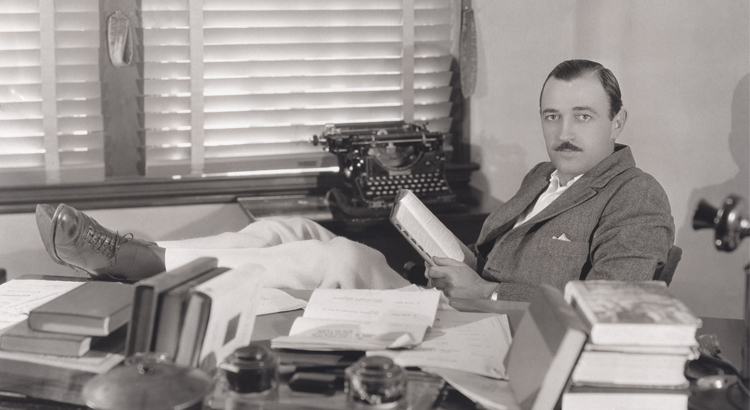
For centuries, authors have been providing us with great stories of adventure, mystery, romance, comedy, and so much more. If you’ve ever found yourself wondering how they do it, you’re not alone! We were curious too, so we set out to find the quirkiest routines and most superstitious beliefs that have transpired behind the scenes to create some of the greatest pieces of literature in history. But don’t take our word for it; without further ado, here’s our list—we hope you enjoy reading it as much as we did compiling it.
Victor Hugo (1802-1885)
Most known for: Les Misérables
Victor Hugo’s antics while writing The Hunchback of Notre Dame on a very tight schedule is the perfect way to start the list. In order to hit his deadline, Victor put himself on self-imposed house arrest for months, knowing that he would have to start paying fines if he didn’t hit his February 1831 deadline! He locked his clothes away to avoid any temptations to leave and only allowed himself to keep one grey shawl so he would be forced to stay inside and write.1
James Joyce (1882 – 1941)
Most known for: Ulysses
James Joyce was known for writing while lying on his stomach in bed with a large blue pencil, donning a white coat. Since James was nearly blind, the large writing utensil helped him see what he was writing and the white coat helped reflect more light onto the page. A typewriter would have helped him write easier and faster; however, he straight out refused because he was always seeking the “perfect order of words in the sentence” and wanted to write at his own pace and in his own hand. After what James would have considered a productive day, he would have completed two sentences.2
Edith Sitwell (1887-1964)
Most known for: Still Falls the Rain
British poet Edith Sitwell found inspiration in confined spaces. Before she would start writing for the day, Edith would always clear her mind by laying in an open coffin.3
Agatha Christie (1890-1976)
Most known for: Murder on the Orient Express
Agatha Christie had her own favorite writing place—in the bathtub. When she was renovating her home, Agatha had one request for the architect: “I want a big bath and I need a ledge because I like to eat apples.” For her, it was not about indulging; the bathtub was her prime work space.4
Agatha Christie books available here.
Vladimir Nabokov (1899-1977)
Most known for: Lolita
Vladimir Nabokov wrote entire novels on index cards. This allowed him to write scenes non-sequentially, as he could then easily rearrange the cards as he wished. Fun fact: his novel Ada was written on more than 2,000 cards.5
Nabokov in America: On the Road to Lolita available here.
Thomas Wolfe (1900-1938)
Most known for: Look Homeward, Angel
Thomas Wolfe gave himself a writing quota of ten pages, triple-spaced, every day. Not only did he have a page count to meet, but Thomas would also do this daily writing while leaning over his refrigerator since he was so tall (6’6” to be exact).6
Thomas Wolfe’s You Can’t Go Home Again available here.
Eudora Welty (1909-2001)
Most known for: The Optimist’s Daughter
Eudora Welty used to straight-pin her stories together in strips so they could be seen as a whole as she wrote. Welty even mentioned to a friend once that “[w]hen the stories got too long for the room I took them up on the bed or table [and] pinned and that’s when my worst stories were like patchwork quilts, you could almost read them in any direction.”7
Anthony Burgess (1917-1993)
Most known for: A Clockwork Orange
Anthony’s tool to fight off writer’s block was a dictionary. When he found himself stuck while writing, he would grab a dictionary and attempt to use every last word on the page he opened. When he would come across the need to describe a dull object, he would use the same strategy by attempting to use every word on the page in the description alone.8
Truman Capote (1924-1984)
Most known for: In Cold Blood
While some authors had unique writing habits, Truman Capote brought his superstitions into his writing process. He “wouldn’t begin or end a piece of work on a Friday, would change hotel rooms if the room phone number involved the number 13, and never left more than three cigarette butts in his ashtray.”9
Truman Capote’s A Christmas Memory available here.
Maya Angelou (1928-2014)
Most known for: I Know Why the Caged Bird Sings
Maya Angelou wouldn’t write from the comfort of her own home but would instead rent a hotel room on a monthly basis. She would routinely start at the crack of dawn right until the early afternoon. Nobody would be allowed to enter during that time unless it was to clear out items in the room to remove distractions. The only items she allowed exceptions for were “a bottle of sherry, a dictionary, Roget’s Thesaurus, yellow pads, an ashtray, and a Bible.”10
Maya Angelou books available here.
Stephen King (1947-present)
Most known for: The Shining
Stephen King may be known for his horror writings but that does not mean he is impervious to fear. Stephen King suffers from triskaidekaphobia – fear of the number 13. He has said that, “[w]hen I’m writing, I’ll never stop work if the page number is 13 or a multiple of 13; I’ll just keep on typing till I get to a safe number. When I’m reading, I won’t stop on page 94, 193, or 382, since the sums of these numbers add up to 13.”11
The Stephen King Companion available here.
George R.R. Martin (1948-present)
Most know for: A Song of Ice and Fire Series
George R.R. Martin considers himself “a man of the 20th century” because he still writes with a DOS computer that is not connected to the Internet. He uses WordStar 4.0 as his word-processing system and says that this program (released in the late ’70s) “does everything I want a word processing program to do and it doesn’t do anything else. I don’t want any help. I hate some of these modern systems where you type a lowercase letter and it becomes a capital. I don’t want a capital. If I wanted a capital I would have typed a capital.”12
George R.R. Martin books available here.
Dan Brown (1964-present)
Most known for: Angels & Demons
Dan Brown concentrates on his writing by putting on a pair of gravity boots and hanging upside down since he believes inversion therapy helps with his writing process. On top of that, he also keeps an hourglass on his desk so that on the hour, every hour, he sets aside his work to do push-ups, sit-ups, and other exercises.13
Dan Brown’s Angels & Demons available here.
J.K. Rowling (1965-present)
Most known for: Harry Potter Series
J.K. Rowling refuses to title a piece during the writing process and has said that she will only type up the title page once the book is completely finished.14
Valerie Stark
Marketing Coordinator
Book Depot
______________________
1 Joyce, James. 1966. Letters of James Joyce. London: Faber and Faber.
2 Johnson, Celia Blue. 2013. Odd Type Writers. New York: TarcherPerigee.
3 Ackerman, Diane. 1990. A Natural History of the Senses. Vintage Books USA.
4 Johnson, Celia Blue. 2013. Odd Type Writers. New York: TarcherPerigee.
5 Ackerman, Diane. 1990. A Natural History of the Senses. Vintage Books USA.
6 Wolfe, Tom. 1991. “Tom Wolfe, The Art of Fiction No. 123.” The Paris Review (118). https://www.theparisreview.org/interviews/2226/tom-wolfe-the-art-of-fiction-no-123-tom-wolfe.
7 Marrs, Suzanne. 2011. What There Is to Say We Have Said: The Correspondence of Eudora Welty and William Maxwell. New York: Houghton Mifflin Harcourt.
8 Illuminati, Chris. 2017. “10 Odd Writing Habits Of Famous Authors.” https://www.oddee.com/list/odd-writing-habits-famous-authors/.
9 Inge, M. Thomas. 1987. Truman Capote: Conversations. Jackson: University Press of Mississippi.
10 Angelou, Maya. 1990. “Maya Angelou, The Art of Fiction No. 119.” The Paris Review (116).
11 Rogak, Lisa. 2009. Haunted Heart: The Life and Times of Stephen King. New York: Thomas Dunne Books.
12 Martin, George R.R. 2014. “Game of Thrones author George RR Martin: ‘Why I still use DOS’.” BBC. http://www.bbc.com/news/technology-27407502.
13 Henley, Jon. 2013. “How Dan Brown and other authors defeat writer’s block.” The Guardian. https://www.theguardian.com/books/shortcuts/2013/may/13/dan-brown-authors-writers-block.
14 Rowling, J.K. 2015. “The Weird World Of Writer Superstitions.” Writers Relief. http://writersrelief.com/blog/2015/10/writer-superstitions/.