Book Depot Shopping Experience

February 14, 2018

In the heart of the Niagara Region—a place that is known for its beautiful vineyards, countryside, and of course Niagara Falls—sits the warehouse and home to Book Depot. At a sprawling 450,000 square feet, our building has a long history and likely many stories to tell, starting with its early days as a paper mill all the way to the major reconstruction it underwent to become the fully automated warehouse that it is today (Click here to read more about Book Depot’s origins). Featuring a sortation machine, miles of conveyors, and even robots to help manage the flow of product, it can seem like a complicated operation. As time shifts and the technologies do as well, however, I think there’s one thing that both wholesalers and retailers alike believe—that the physical presence of books is often best appreciated in person.

Book Depot shopping experience


Technology has afforded buyers some pretty amazing options, such as the ability to simply scan through Excel spreadsheets and PDFs to purchase product for their stores. While these options have proved to be a great resource, the one experience they cannot provide is that of seeing the books in person. Some believe that certain books can be judged by their covers, and that their shelf appeal can be a great factor in their success. Book Depot has for many years opened our doors to wholesale customers from around the globe who, with this principle in mind, have come in the search of new titles.


Why Choose Book Depot?

In dealing with the industry’s leading publishers, our company has been able to amass a collection of almost 60,000 titles, which we’re proud to say leads the bargain book industry in terms of selection. To showcase this selection, we’re extending an invitation to our wholesale customers to come in and see some of the exciting changes we’ve made as a company, as well as shop in a clean, warm, organized, and friendly environment.


Our full inventory can be accessed by perusing the three levels of our main warehouse space, and entering titles into an order couldn’t be easier. We provide handheld scanners, which allow our customers to quickly scan a book’s ISBN to find out the quantity we have in stock, further details, as well as to add it to their order if desired.


As a second option, many of our customers will use our showroom, which generally features books that we have in a higher quantity. Often, this means we have 100+ copies available in our inventory. From within the showroom, you will have the comforts of a kitchenette, WIFI, lots of table space, carts to stack books on, and perhaps even some peace and quiet! At any given time, our showroom features up to 20,000 titles and is updated weekly to add new titles and remove those that have sold out.

Book Depot Warehouse-105


Book Depot currently ships to 80+ countries around the world and we’re very proud to have hosted wholesale shoppers from many of them throughout the years. While we understand the challenges that travel presents, we work closely with visitors and receive preferred rates from some of the best hotels that Niagara has to offer. We are also happy to supply a letter of invitation to customers who may be originating from a country that has visitor visa requirements.


To both our long-term and new wholesale customers, you’re invited! We’d love to show you around Book Depot and provide what we consider one of the best shopping experiences you can find in this industry. For further information, please reach out and speak with your sales representative or our customer service team, who will be happy to answer any questions you may have.


Paul Blog Signature Book Depot Sales Rep

Sidebar

Hiring Basics: Tips to Help Find the Right People

December 27, 2017

Hiring is not an easy task, but if you have a good plan in place, you’ll be well on your way to finding the right people for your company. Read on for some tips and guidelines to keep in mind when you’re hiring your next team member.


Know the Position You’re Hiring For

Before you post a job ad, the first thing you should do is come up with a list of responsibilities for the position. This will serve as the basis for the rest of the hiring process. If you’re overseeing the hiring for a department that you’re not part of yourself, ask the department manager or supervisor for more details—they will have the best idea of their department’s specific needs. Beyond job responsibilities, some other basic factors to consider are: Is this a brand new position, or are you looking to fill an existing one? Is it full time, part time, or contract? What will the salary or hourly wage be? How many hours per week does the position require? Is it an entry-level position for which candidates do not need any previous experience, or is experience/schooling necessary? Knowing all of this information beforehand will help you find the most suitable candidates for the position, as well as help prevent you from inadvertently representing the position in a misleading or contradictory way.


Have a Plan

You’ve posted a great ad and interested candidates have sent in their resumes. Now you’ll need to prepare an order of operations for the selection process: Which staff members will be participating in the interviews? What will their roles be? Will there be one interview or two (or more)? Will the first interview be conducted via phone? Will you issue a personality/aptitude assessment, or a project? What is the expected timeline? When will you contact candidates for each stage of the process? Having a clear roadmap (and communicating it with your candidates) will help keep you on track, organized, and professional.


Consistency is Key

It is important to treat all candidates fairly throughout the selection process. Come up with a standard list of questions to ask everyone you interview for the position. If you plan to issue an assessment or project, ensure you use the same terms, timeline, and criteria for each candidate. Using consistent evaluation methods for everyone will go a long way in helping you to determine the successful candidate.


No Surprises

Make sure you and your candidates are on the same page from start to finish. If you’re hiring for a contract position that has a definite end date, clearly specify this in the job ad and reiterate it during the interview process. If the position requires specific experience, education, or equipment, be upfront about it; don’t wait until both you and your candidates have invested a significant amount of time in the selection process to find out you’re not going to be a good fit for each other.


Take Notes

Whether you’re meeting with three candidates or ten, it’s good practice to take thorough notes each time you sit down for an interview. With everything else that is going on in your busy day, remembering who said what will be one less thing you have to worry about. You’ll also have something tangible to refer back to for any follow-up interviews or contact, making it that much easier to navigate the selection process.


Consider the Culture of Your Workplace

Your company’s culture—which is continuously reshaped by everything from the unique personalities of your staff members, to the goals and values of your company, to the working environment itself—plays a large part in both hiring and retention. A thriving company culture attracts qualified applicants, and perhaps more importantly, gives them a good reason to stay! When hiring, look for candidates who have the potential to positively impact your company’s culture; our CEO Wilf Wikkerink wrote a fantastic blog post at the beginning of the year titled “The Right People on the Bus” that covers this topic in greater detail—we suggest you check it out.


Have any questions or tips of your own you’d like to share? Leave a comment below or email us directly at jobs@bookdepot.com—we’d love to hear from you.


Faeryn Genovese

Book Depot

Human Resources Coordinator

Sidebar

The Right People on the Bus

September 27, 2017

It is often said that people are your greatest asset, but Jim Collins said it much better in his national bestseller Good to Great when he wrote, “People are not your most important asset.  The right people are.”[i] Collins used the analogy of the company being like a bus and spoke a lot about getting the right people on the bus (the company) and that once you get the right people on the right seats (the right positions) of the bus, you can drive the bus anywhere. The reality is we will often spend more time with our colleagues than with our family members, so getting the right people on the team is of paramount importance to building a successful company and one that people want to be a part of.


Increasingly over the past number of years I have realized that attitude is everything when it comes to getting and retaining the right people. There’s a common saying that we should hire for attitude and train for skill, and I believe this is more relevant than ever as the pace of change in business continues to move at an alarming rate. Employees who are positive, love life, and are engaged in the vision of the company will adapt quicker to change and are more willing to follow leaders who take them down new and uncharted territories. Of course, there are certain hard skills that are required for any job and some more so than others—I would most certainly fail if I was hired to be the head programmer of a software development company. However, a highly skilled and experienced member of your team with a negative attitude will be a cancer in your organization and will ultimately fail themselves. Someone who has less experience and fewer hard skills but a positive and infectious attitude will always outlast the more skilled employee and will be much more beneficial to the overall culture of your company.


Jack Welch outlines five qualities in his book Winning that we need to look for in people to create a winning team. These five qualities are: positive energy, the ability to energize others, the courage to make tough yes/no decisions, the ability to execute, and passion.


When you read through the above list it seems so simple, and yet so many of us hire people with only some or none of these qualities. Then, when we realize we’ve made a mistake, we lack the courage to move those people out of the organization for their own well-being and the good of the company. One of the first questions I ask my HR manager after an interview is, “did they have good energy”? Who doesn’t want someone on their team who comes into work each day with a smile on their face and the attitude that he/she can take on whatever comes their way?


Those who have energy are also infectious to those around them; if they are excited about life, both at home and at work, it will energize those around them to be the same way. You can see how a few of the right people with positive attitudes can have a huge impact—I’ve seen whole departments completely turn around by getting the right people in the right seats on the bus, and it’s one of the most rewarding things to witness as a leader.


One of the more difficult soft skills to hire for is what Jack Welch calls “edge.” We must find people that have the courage to make tough yes/no decisions. Anyone can analyze a situation from every angle, but great people have the ability to cut through the murkiness and make the call. Many difficult calls must be made with little information and will require that gut decision. As leaders, we need to encourage our team members to make decisions, knowing that sometimes they will make the wrong one. It is important that we impart to our team members that they won’t “get shot” for making the wrong decision as long as they learn and grow from it.


The next key quality is the ability to execute. We may be able to find someone who has the energy, excels at energizing others, and has the courage to make tough decisions, but if they cannot execute, nothing will get done. Successful teams are full of people who can see the end goal and map out a plan to reach the goal, no matter what comes their way. Having goal-driven people on your team is absolutely imperative to delivering results year after year. One of my favorite business books on the subject of execution is Execution: The Discipline of Getting Things Done by Larry Bossidy and Ram Charan—it is definitely a business book you want on your to-be-read list.


The last quality is the notion of passion. Successful teams are full of people who absolutely love their work. They enjoy coming to work each day and ultimately feel like they’ve never worked a day in their life. The right people aren’t just passionate about work, however; they are normally passionate about all of life. They have a vigor for life, whether that be in their hobbies, their family life, their churches, sports clubs, etc., and they live fulfilled, purposeful lives.


If you find people with these qualities, do everything you can to retain them, take care of them, grow them, and reward them for successes; by doing so, you will create a team with A players who will be a pleasure to work with and will consistently deliver results for your company. I’d like to leave you with this closing quote from Jim Collins in his book Good to Great:


For no matter what we achieve, if we don’t spend the vast majority of our time with people we love and respect, we cannot possibly have a great life. But if we spend the vast majority of our time with people we love and respect – people we really enjoy being on the bus with and who will never disappoint us – then we will almost certainly have a great life, no matter where the bus goes. The people [we] interviewed from the good-to-great companies clearly loved what they did, largely because they loved who they did it with.[ii]


Wilf Blog Signature

————————————————————————————————

[i] Jim Collins, Good to Great (New York: HarperCollins, 2001), 13.

[ii] Collins, Good to Great, 62.

Sidebar

Customer Success Story: The Ella Fitzgerald Charitable Foundation

September 6, 2017

Customer: The Ella Fitzgerald Charitable Foundation

Business: Nonprofit Organization

Website: ellafitzgeraldfoundation.org

The Ella Fitzgerald Charitable Foundation is able to successfully sustain the “A Book Just for Me!” program through Book Depot’s unbeatable, low prices.


The Ella Fitzgerald Charitable Foundation

The Ella Fitzgerald Charitable Foundation, established in 1993 by the late American jazz singer Ella Fitzgerald, assists at-risk and disadvantaged individuals and families in communities located predominantly in Los Angeles, California, and the surrounding area. One of the foundation’s aims is to help provide educational opportunities for children, which they do in part through their “A Book Just for Me!” book give-away program. The foundation supplies books to 100 nonprofit organizations each year through this program, which was created in memory of Fitzgerald following her passing in 1996. As of 2016, the foundation has given books to hundreds of thousands of children, ranging in age from birth through to college.


In order to keep the “A Book Just for Me!” program viable, the Ella Fitzgerald Charitable Foundation requires a dependable source for new, unread, low-cost book product that is suitable for a broad spectrum of ages and interests, as well as flexible, affordable shipping options to service all of the nonprofit organizations they are partnered with.


Solution

Book Depot’s large inventory of children’s and young adult titles provides the Ella Fitzgerald Charitable Foundation with the selection and quantities they want at the unbeatable, low prices they need to sustain the “A Book Just for Me!” program. Additionally, Book Depot’s ability to ship directly to the foundation’s nonprofit partners using the most economical shipping method for each location helps save the foundation time and money. While the foundation prefers to place their orders online via Book Depot’s comprehensive, user-friendly website, they are also partnered with a sales representative for personalized service.


Results

Since the Ella Fitzgerald Charitable Foundation first began purchasing from Book Depot just over 10 years ago in 2006, we have supplied them with 965,122 units to date at a fantastic average per-unit cost of $0.99 cents, which helps ensure that as many children as possible are able to receive books and benefit from this excellent program.


“There is just no way we could run this program without Book Depot and your amazing selection and even more amazing low prices. We are very, very grateful. (Plus, you are ALL so nice and helpful, what a pleasure!) And you ship wherever we want, which makes my job so much easier. Your website is a pleasure to use.” – Fran Morris-Rosman, Executive Director and Chief Literacy Officer


Sidebar

10 Interesting Facts about the Book Publishing Industry

August 16, 2017

The book publishing industry has a history spanning several decades and many great continents. It is arguable that some may even consider books to be the greatest medium to deliver content in the history of mankind. With so many years behind the publishing industry, it would only make sense that some interesting things have happened along the way.


To pay homage to some of the strangest records, stats, and facts ever recorded in publishing history, we have created a Top 10 list about the book publishing industry for your entertainment. We hope you have fun reading some of the eyebrow-raising, jaw-dropping, and just outright crazy facts we were able to find out about this great industry!


Without further ado, enjoy!


10 Interesting Facts About the Book Publishing Industry

1. According to a survey conducted by The New York Times, 81% of Americans feel they have a book in them. But most haven’t written it.


2. The Bay Psalm Book was the first book to be published in British North America. This was in 1640, just a mere 136 years before the United States became a country and 267 years before Canada was formed.


3. One of 11 original copies of The Bay Psalm Book sold in 2013 for a whopping record of $14.2 million. (Little did they know they could have opened several bargain bookstores for that very same price.)


4. Without paper, we quite possibly would not have publishing! This great invention originated in ancient China during the years of 206 BC – 220 AD. Though that’s not a specific date or length of time, the e-readers certainly have a long ways to go to catch up.


5. Approximately 60% of English-language books are produced through the “Big Five” publishing houses. Book Depot is proud to say that we are currently distributing bargain books issued by all of them and a wide selection of many other notable publishing houses as well.


6. Now an asset to the book selling industry, bargain books have not always been in the picture. In 1986, Book Depot was formed and became a pioneer in this industry, which now distributes many millions of books each year. Can you imagine how much paper was shredded and wasted up to that point?!


7. Books actually come in all shapes and sizes! While we are accustomed to popular formats such as hardcover, softcover, board books, etc., there are some publishers who look to make their mark in a different way. In our warehouse we have seen books as small as a business card, as big as a television, and even ones that are shaped like a wine bottle!


8. Though there is little doubt, the best-selling book of all time is the Bible. According to the Guinness Book of World Records, it is estimated between the years of 1815 and 1975 that a whopping 5 billion copies were distributed!


9. The largest known book to have been published is titled The Little Prince and measured an incredible 6’7” high and 10’1” wide when open!


10. Founded in 1534, the Cambridge University Press is the oldest publishing house in the world. It’s incredible to think they have a 500th anniversary right around the corner!


Paul LinkedIn book industry

Sidebar

5 Tips for Running a Successful Store Event

August 2, 2017

If you think having fun at work is a myth, then you’re wrong! Maybe it’s time to bring some pizazz into your workplace and host an exciting event for you and your customers! Connecting with customers is a deeply important part of running a successful business, and what better ways to connect with the people you cater to than by literally catering to them? Starting an interactive in-store experience for your customers may seem like a daunting task, but in the long run, not only will the revenue reflect your efforts, but you will also have created a whole new community of people within your business.


Here are some tips for running a successful store event:


1. Get the word out

You may have a steady stream of customers throughout the week, but how do you know if putting on a special store event will be worth your efforts? The answer to this is to advertise until you can recite your event details in your sleep. One hugely effective way to do this is through social media. More and more people are turning to Facebook, Twitter, and websites to find details for upcoming events, so make sure it is posted well enough in advance for people to plan around your event! If you spring it on your customers the day of, they may not get the memo and the poor turnout might turn you off of ever putting on another event. Another highly effective way to do this is through word of mouth. Though social media is an expanding phenomenon, there is still a great deal of value in personally informing your customers about your upcoming events. Whether it be just with a friendly reminder, or if you hand them a physical flyer outlining all the details, customer interaction is always effective. Remember, that’s why you’re putting on the events in the first place!


2. Be passionate!! 

If there is something that you are passionate about, don’t hesitate to incorporate it into your events! Many themes I’ve used have been related to my favorite authors, holidays, seasons, animals, etc. Trust me—your customers will know if you are engaged. The more enthusiastic you can be about bringing something new and exciting to your store, the more entertaining and meaningful it will be for your customers. Not to mention, the more engaged you are with your audience, the more rewarding it will ultimately be for your business. By participating and reaching out, you can form important and lasting relationships with people, which will essentially do a large portion of your marketing work for you! When you provide a good customer experience, people are much more likely to pass on the word to friends and family and send many new faces your way!


3. Dollar stores are your best friend

When planning events for a large group of people, it can be hard to fit everything you need into a budget that will still allow for profit. This is where your local dollar store comes in handy! In my experience, I have been able to provide craft supplies, prizes, decorations, and refreshments for 50+ people for under $100, just by shopping smart and making a little go a long way. Buying things in bulk and really getting your money’s worth out of the supplies you purchase makes the day’s sales numbers that much more satisfying.


4. Free is key

If you want your store event to be successful, I have found that advertising FREE attendance for your customers is the key to a larger turnout. Your goal is to get more traffic in your store, and nothing brings bargain shoppers out like free things! The more people you have coming through your doors, the more you’ll have purchasing your product when they may never have stepped foot in your store otherwise. It also never hurts to make noticeable displays of event-related product to catch their attention. Another good tip for advertising a free event is to keep a sign-up sheet and ask your customers to put their names on the list prior to the event to guarantee their attendance. This way you can gain a better estimate of the size of your crowd, and customers will have time before the event to spread the word to their friends and families. That being said, when promising a free event for anyone to attend, make sure you have adequate space to accommodate a large crowd. The word “free” often generates a pretty overwhelming response!


5. Think outside the box

Don’t be afraid to seek outside help for your events! There is a wealth of available services geared specifically towards catering to corporate events. Whether it is a magician, a live animal show, or an art workshop, there are always new and affordable ways to bring something exciting into your place of business. Many entertainment companies are also more than willing to provide discounts and extra deals to suit your needs, so it always helps to call and speak personally with your potential guests before booking.


Regardless of which direction you decide to go in with your events, remember that they are yours and if you’re not having fun with them, then your customers won’t either. Whether it is an event geared toward children, family, or adults, the more engaged you are in what you’re doing, the better success you will have. Participating in fun activities different from your daily routine will not only improve your relationship with your customers, but it is an excellent team-building exercise for you and your staff as well. The more involved you become within your surrounding community, the bigger your customer base will grow and you will find that work can be more fun than you thought it could be!


Samara Bissonnette

Book Outlet

Retail Store Manager


Sidebar

Everything You Need to Know about Remainder Marks

July 12, 2017

“Is it necessary to mark your books?” “Why are the marks so big?” “Can they be a different color or shape?” “Why do you put that mark on your books?” These are just a few of the questions we regularly receive in regards to the infamous remainder marks that can be found on many publisher overstock books. At Book Depot, we are conscious of feedback from our partners and wanted to take a moment to help explain the process for these often misunderstood marks.


These marks serve a purpose in the publishing world, dictated and added by the publishers themselves. When a book first goes to the retail channel, the balance of unsold stock is returned to the publishers for credit. At that time the publisher marks each book to signify it has previously been through the retail channel. Without that designation, publishers would not be able to distinguish the proper life-cycle of their inventory, forcing them to treat all books as new.


So, ultimately, what do remainder marks mean to you?


In a nutshell, it means deeper discounts, a better sell-through rate, and higher retail margins for your store. Book Depot leverages its strong publisher relationships to garner a huge assortment of categories and titles, which we then make available to you for up to 90% off of the original retail price. Usually, the remainder mark is barely noticeable to the end consumer, and some books do not even have one at all. However, if your customers do ask, you can tell them it is there so they may purchase fantastic books at incredible prices.


To help illustrate our point, we have compiled an infographic to walk you through the remaindering process and why it is significant to your business.


From publishers to shelf and back again the life cycle of a bargain book

Sidebar

Reflection on Book Expo 2017

June 15, 2017

Each spring, the Book Depot sales team embarks on our annual trip to Book Expo America (BEA), the premier event in North America for publishers, book distributors and wholesalers, booksellers, and generally anyone related to the book trade. I think back 17 years ago to Book Expo 2000 (yes, the world did not end that year!), when three people including myself and one of our owners made the trek to attend our very first BEA as exhibitors. We set up our little 10’ x 20’ booth and were ready for business, a little minnow in the ocean of bookselling and publishing. We did come home that first year with a nice order from one of the big retailers in our pockets, along with meeting some of the other great contacts in the bargain bookselling industry, and so began our long relationship with this show.


Eighteen BEAs later, it was off to New York City for this year’s event. We now have a booth that is 10’ x 70’ on both sides of an aisle that runs through the middle of our booth to allow attendees to walk through our corridor of book offerings. That is a total of 1,400 sq. ft. compared to our meager 200 sq. ft. from 17 years ago. We had approximately 8,000 samples at the show in either full-book format or, for a couple of categories, just the front covers for customers to flip through. The show proper opened on Wednesday, May 31 at 1:00pm for bargain booksellers, but there were a handful of buyers who were in the city even earlier, looking for anyone doing “pre-show” selling. That precipitated me selling from my hotel suite already on Monday morning, working with a handful of accounts. Tuesday was set-up day, a day that all of the sales reps circle on their calendars and look forward to with much joy and excitement. Not!!! For most of the reps, it was up early and off to the Buffalo airport to catch an 8:00am flight to NYC. I was the “advance team” this year, so I was already at the Javits Center by 8:00 am to make sure all our pallets had arrived at the floor location and get the carpet down before everyone else arrived. The entire team was pretty much assembled by mid-morning, and we were busy putting together shelves, opening boxes, and displaying the books over the next 8 hours, transforming a bare exhibit floor into the Book Depot bargain book showroom.


Wednesday brought the start of the show, and even though it was scheduled to begin at 1:00pm there were a few buyers who had advance passes to access the show floor early so we kept busy from 9:00am until closing at 6:00pm. For bargain booksellers like us, these shows tend to be very busy at the beginning, as buyers want to come in early and get the good books before they are all gone, knowing there is a limited supply. Typically we will have a very busy first day where we will do 75% of our business, and then the show will dwindle down over the next couple of days with minimal activity going on by the final day. By the end of the first day, you pretty much know if it will be a successful show or not. This year our first day was fantastic. Over the years with more of our customers buying from our website, doing warehouse visits, or maybe reviewing focused lists supplied by a sales rep, we have seen a trend towards fewer buyers attending the trade shows. However, this year at BEA was a bit of a throwback to the old days where we had lots of appointments, and buyers came with pen in hand ready to write some big orders.


As the week went by, some of us were able to leave a bit early, while others headed out late Friday afternoon, and Dave Wiggins, our Sales Manager, hung in right to the end to close the show and pack up the supplies that needed to come back the warehouse before catching the late flight home. We are all glad to be back safely, and Book Depot’s 18th Book Expo is now in the books—at least from a sales standpoint. There is still some follow-up to do with new prospects, but for the most part, the baton has been passed off to the warehouse to do the awesome job of pulling, cleaning, and packing all these orders, and then handing them off to our shipping team to get them out the door. Thank you again to everyone who stopped by to say hello or place an order, and we look forward to another great show again next year!


Rick Mechelse

Senior Sales Representative

Book Depot

Sidebar

5 Essential Elements of Social Media Customer Service and Why You Need Them

May 18, 2017

If your business isn’t active on social media, it needs to be.


Seventy-four percent of consumers use social networks to help them make purchasing choices. This study of more than 23,000 online consumers who interact with companies via social media found that 67% of these interactions were for customer service reasons.


What can we conclude from this? Firstly, that the impression you leave on social media is crucial to influencing your customer to buy. Secondly, if people are seeking you out on social media, it is most likely for service rather than for an interest in your marketing.


So why do customers choose social media instead of the traditional phone call or email? Convenience is the answer. In today’s fast-paced society, consumers don’t want to waste their valuable time on hold to speak to customer service. Forty-two percent of customers who reach out through social media expect a response within 60 minutes. While social media hasn’t yet replaced the telephone or email, it is quickly becoming one of the main forums customers use.


Keeping this in mind, how can you best use social customer service to benefit your business? Here are some strategies for you to consider:


1. Consistently monitor your social media pages and respond to customer inquiries ASAP

Keep your Twitter, Facebook, Instagram, etc. pages open and refresh them as often as possible. Since customers expect a response within 60 minutes or less, you will want to check frequently for any inquiries or comments, as well as direct messages. You can keep most social customer service conversations public—customers who are leery of buying online or from your company will gain confidence that your brand can be trusted when they see proof of great customer service. Any inquiries that require follow up or that involve personal information (tracking numbers, payment information, or account details, to name a few possibilities) should be moved to direct message if it is available. If direct message is unavailable (for example, on Instagram), ask the customer to send the information to you through email and make sure that the proper follow up is provided. Be sure to post your hours of availability on your pages so that customers will not be frustrated if they reach out to you outside of business hours and need to wait for a response. You will also want to have a link to your website posted so that they can look there for more information.


2. Be proactive

Show your customers that you have an ear to the ground for their needs and that you truly care. It is one thing to respond to a customer, but finding customer issues and resolving them before the customer complains provides a high level of service. For example, you can search for your business name on Twitter and bring up conversations that are about you but aren’t directly tagging you. You may also Google search your business name and keywords to bring up relevant posts (i.e.: your business name + review). If you find positive comments or discussions, it is courteous to thank them for their words. If you find a situation that needs addressing, you are able to solve the problem and impress your customers with your thorough attention.


A different way of being proactive is by preventing customer complaints through social media in the first place. You can effectively reach your followers with important messages that may have an impact on your service. For example, you can tweet and post on Facebook that you are closing early due to inclement weather before the customer shows up and leaves upset. This kind of gesture changes the framework of the customer service conversation into a positive one rather than always doing damage control.


3. Make it personal

Although customers expect quick responses, they do not want to be given a cookie-cutter or thoughtless answer. When space permits, use the customer’s name and sign off with your own. (Note that initials are acceptable on Twitter due to character limits). Ensure that your responses match the tone of the person reaching out—it’s appropriate to be more casual with social media than you would in email.


4. Surprise and delight

Sometimes it is beneficial to go above and beyond good customer service when addressing concerns on social media. Many companies have had random acts of kindness for customers go viral—this is the kind of attention you want drawn to your brand. See the example here of what Lego did for a little boy who lost his toy. While it is not feasible to offer free product to everyone who asks, from time to time you may wish to do something special for your followers to see.

5. Know when to ignore someone or delete a post

Although you definitely want your customers to see you turning upset customers around, there are times when it is necessary to end the conversation before it starts. Social media is an excellent way to reach a lot of people, but this can backfire when your customers are exposed to posts or comments that are inappropriate or insulting. Be sure to delete posts or comments that are belligerent to other customers, use foul language, or are discriminatory in any way. These people likely cannot be turned around anyways and are using social media as a way to vent and spread negativity for their own enjoyment.


While it reflects poorly on the company to ignore posts directed at you, if you are socially sleuthing and come across someone that repeatedly complains despite multiple attempts on your end to make things right, you can let it go. Some customers will become more annoyed if you reach out to them too many times asking if you can assist them, especially if these are conversations that are going on in the background and not on your pages.


The more you reliably interact with customers socially, the more likely your other followers are to reach out in the same way. You will develop a rhythm and a style that works for you and helps you to address all inquiries efficiently and effectively— and your customers will trust your brand as one that offers comprehensive and conscientious social service.


Written by:

Jaimie VanAmerongen

Book Depot Marketing Team


Sidebar

Retail Store Event Feature: Annual Box Sale

April 21, 2017

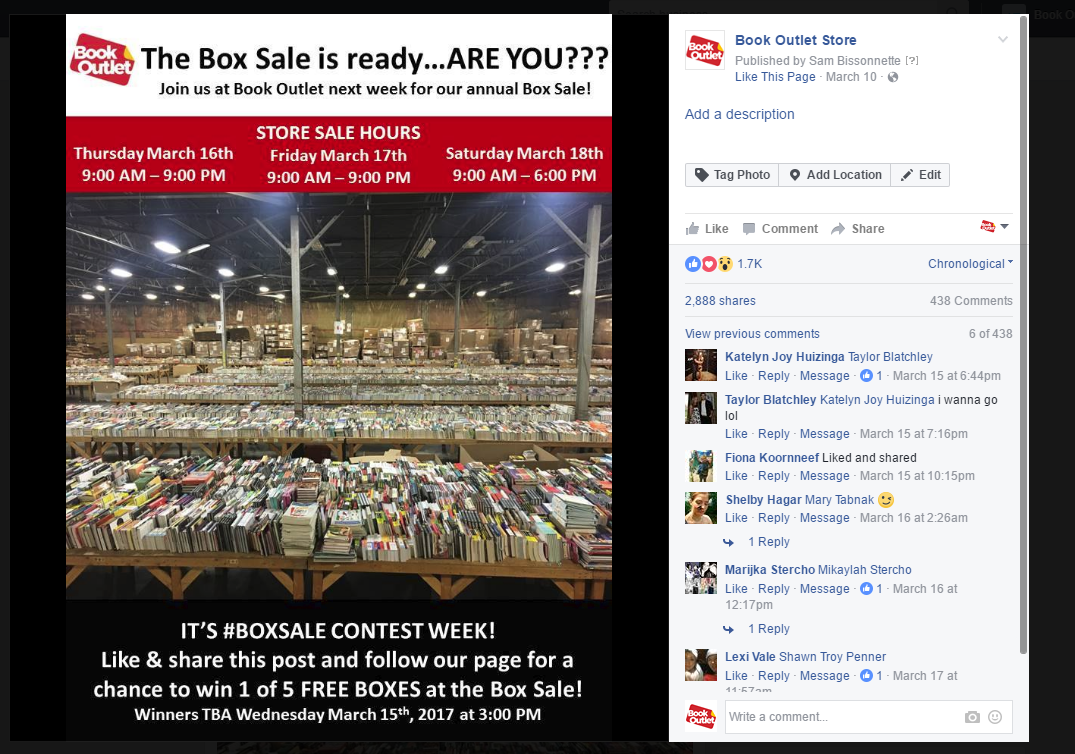
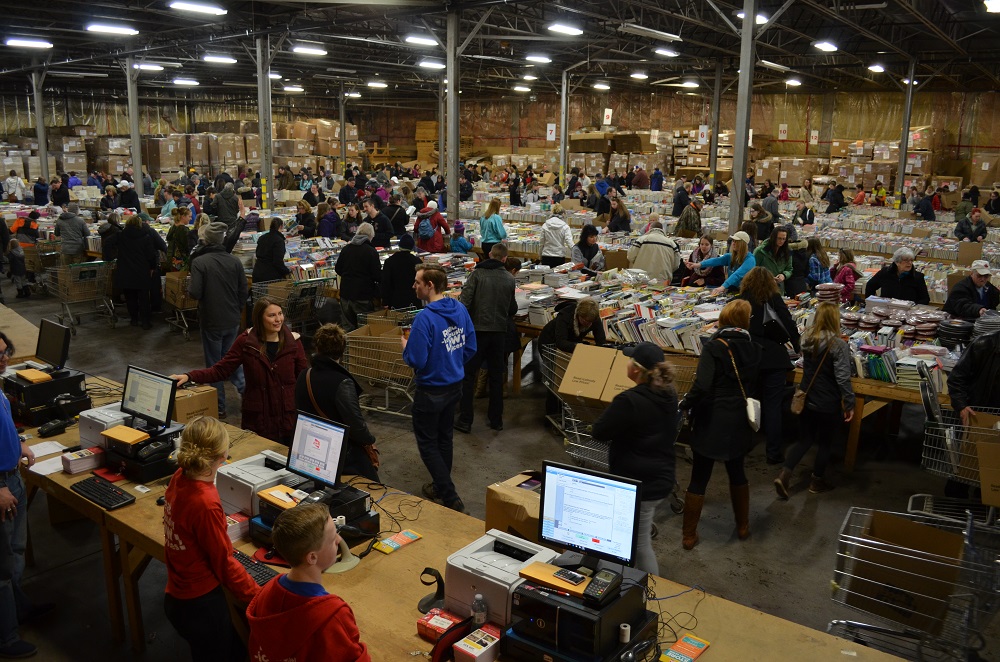
Every year on the March break, book-loving customers come from far and wide to visit our retail store location and participate in the Book Outlet Box Sale. Tables upon tables are filled with damaged product or slow selling/excess titles that are accumulated over the year from our warehouse location. About a year goes into preparing the 24,000 sq ft warehouse to become a veritable candy factory of books, lined with overladen tables. It has become such a popular local event that our marketing was made easy by the enthusiasm and involvement of the customers, proving day after day that they look forward to this year-round.

Box Sale 2017

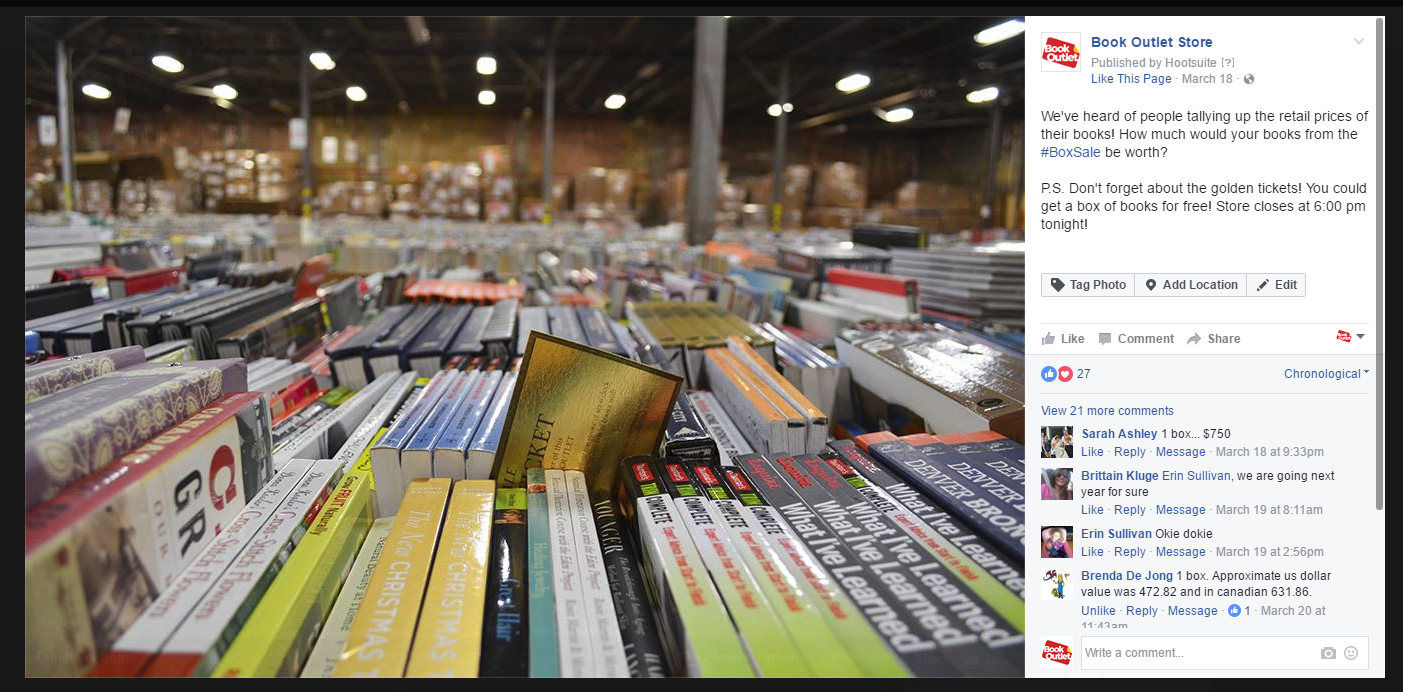
This year’s sale proved to be one of the very best in several regards. The product we procured over the year was a big driver of sales. We were selling books by Emma Donoghue, Stephen King, Jeffrey Archer, Ken Follett, Oliver Jeffers, Sandra Boynton, Julia Donaldson, and so many more! It’s no wonder our customers came in chaotic droves first thing in the morning to rush in and peruse the tables. In past years, we have been accustomed to a line up at the door and rush when we open, but this year was an exceptionally busy year, partially due to the excellent social media campaign that got our customers so excited for this event. As well as visual teasers and daily advertising, we ran a number of new and thrilling contests for our customers, such as hiding boxes in the store and having people rush in to find them, hosting coloring and writing contests for the youth, and a Facebook Like & Share post that reached over 218,000 people, all with the enticing prize of a free box at the sale. Perhaps the most exciting promotion we ran throughout the sale was our Golden Ticket promotion, where we hid a number of shiny tickets within the stacks of sale books, which also entitled the customer who found it to a free box of books at the sale. As a result of all of this incredible dedication and effort from the store staff, we exceeded our past sales results, making this year the best Box Sale ever at a total of 3536 boxes in three days.


We hope this might inspire you to run your own exciting sale in your store that garners a lot of attention! Do you have more questions about the sale and promotions leading up to the event? Please comment below.


BS March 10 2017

Box Sale 2017 3

Box Sale 2017 4

BS March 18 2017 Post 3

Sidebar