Custom List Tool: Multiple Keyword Search

February 1, 2019

Have you ever found yourself searching keyword variation after keyword variation to see all of the books available about a certain topic? The time has come where that manual (and no doubt tedious) process is no longer needed!

With Book Depot’s new Custom List tool, we have created a very easy way for you to search your keywords in our list generator. Now you have the ability to enter multiple keywords at one time and receive an immediate list of all the results where the keywords appear in the title and/or overview! For example, if you are interested in a list of keywords that is pertinent to your location, you may be searching for words related to the city, state, province, and/or country as well as any significant terms tied to your surrounding landmarks or geographical features. Now you can take all those keywords, compile them into one list, and search that against our entire inventory to find books that will be important to your business.

What’s even better is that once your list is created, you can refer back to it as often as you want or even create a template to have that list emailed to you at the frequency of your choosing.


Video Tutorial

Here is a brief video tutorial to show you how to use this tool:


Step-by-Step Instructions

Once you are logged into your account, you can find our Custom List tool under the profile icon at the top of the webpage in My Lists (or by clicking here). When you get to the page, you may notice that you already have a list or two already created. These are example lists we have created for you to help get you started and to aid your browsing experience.


GETTING STARTED

To create a Keyword list, start by clicking on Create. You will see a list of several attributes that you can create a list from. For the purpose of this tutorial, check the box next to Keywords and select Next to proceed to the next page.


KEYWORDS

On the Keyword page, you are presented with a couple options before you begin your search—Search Areas and Search Method.
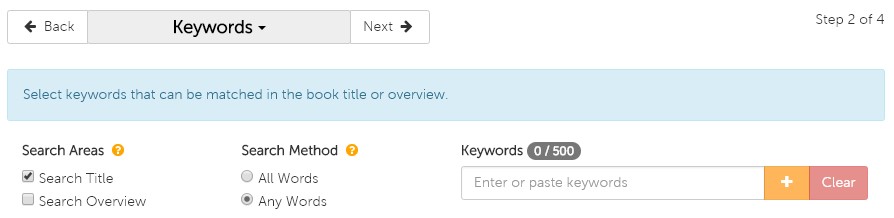
 

Keyword options


Search Areas

Search Areas determines which fields are included in the search. Under Search Areas, you are given three options:

  1. Search Title: search for your keywords in only book titles
  2. Search Overview: search for your keywords in only book overviews
  3. Both (check the boxes beside both Search Title and Search Overview): search for your keywords in both book titles and overviews

The default is set to search titles only but if you would like a more comprehensive search, we recommend you select both.


Search Method

Search Method determines how exact you would like the list generator to be when populating your list. Under Search Method, you are given two options:

  1. All Words: the search will look for results that include all keywords that are entered (e.g. if you were to enter 10 keywords, only results that include all 10 will be populated)
  2. Any Words: the search will look for results that include any of the keywords that are entered

The default is set to search any words, which will be most commonly used.


Now it’s time to add your keywords! You can either type them in one by one and click the  symbol after typing each keyword, or if you have a list already created in a text file or Excel spreadsheet, you can copy and paste that into the search bar. You can see how many words you have added on the counter just above the search bar, where you will be capped at 500.


REPORT FIELDS

On the Report Fields page, you have the ability to select the information you would like included in your downloadable Excel spreadsheet list. We have preselected several for you but you can alter these options to whatever you prefer. You even have the option to include the cover image, but please note that if your list exceeds 1,000 titles, the images will not appear due to file size constraints. When you are satisfied with your selections you can continue to the final step by clicking Next.


FINALIZE

On this last page, you will finalize your list and then move it to a shoppable format or create a template from the list and schedule it to be delivered to your email. The Review section gives you the ability to make any last-minute changes to any of the attributes that make up your list. Since we only selected Keywords for this list, all the other attributes listed should have All included or No filters applied listed. The only attribute that will be impacted from this tutorial is Keywords, and that will specify how many Keywords you selected.

The Name section is your next step, where you simply need to name your list. Once you have done that, you have the option to create a template by checking the box beside Create as template. If you choose to create the template, a scheduling program will appear that gives you several options including frequency of recurrence (weekly, monthly, yearly), start and end dates, day of the week, etc. You need to include the email address(es) that you want to send to list to, and you can also create a subject and message for that email to remind you of what you are receiving. Whether you choose to create a template or not, you must finalize the list by clicking on the green Create button at the bottom of the page.

If you decided to just create the list and not template it, you will see a pop-up to either view the list on our site using a special viewing page which allows you to add items to your cart, or to download the list to an Excel spreadsheet.


TEMPLATES

If you chose to create a template, you will see that list under My Templates. To view it immediately, you need to select Create Now and that list will be moved over to My Lists. By doing so, you now have the ability to open it on the custom view page on the site, or you can also download it to an Excel spreadsheet under Actions.


If you have any questions about this tool or any other functions of our Custom List tool, please contact us!

Email: [email protected]

Phone: 1-800-801-7193

Sidebar

Custom List Tool: Favorite Authors List

January 16, 2019

We think it would be fair to say that many wholesale buyers likely have a go-to list of their favorite authors—whether it’s written down or just a mental list—whose books typically guarantee sales and are always in demand by customers.

With Book Depot’s new Custom List tool, we have created a very easy way for you to upload your unique author list(s) of any size to our list generator. There is no longer a need to plug in one author at a time in the search bar. Now you can upload them all at once and shop the entire list! Once your list is created, you can refer back to it as often as you want or even create a template to have that list emailed to you at the frequency of your choosing.


Video Tutorial

Here is a brief video tutorial to show you how to use this tool:


Step-by-Step Instructions

Once you are logged into your account, you can find our Custom List tool under the profile icon at the top of the webpage in My Lists (or by clicking here). When you get to the page, you may notice that you already have a list or two already created. These are example lists we have created for you to help get you started and to aid your browsing experience.

GETTING STARTED

To create a Favorite Authors list, start by clicking on Create. You will see a list of several attributes that you can create a list from. For the purpose of this tutorial, check the box next to Author and select Next to proceed to the next page.

AUTHOR

On the Author page, allow a few seconds for the page to load with the thousands of authors that are in our database. In the filter bar you can start typing in the names of your targeted authors, but please remember to use the sequence: last name, first name. As you type in the name, the list will begin to filter down your selection until you see the author you are looking for. When you see the author’s name that you are interested in, simply check the box next to their name. You will now see number alongside the Author heading above the filter bar indicating how many authors you have selected.

To make this process even quicker for you, you also have the option to import a list that you have already created in either a text or Excel file. Simply copy and paste your list into the filter bar, remembering again to use the correct format (last name, first name), and all the author matches we have in our database will be added to your list. When you have added all the names you desire, you can move onto the next page by clicking Next.

REPORT FIELDS

On this next page, you have the ability to select the information you would like to be included in your downloadable Excel spreadsheet list. We have pre-selected several for you but you can alter these options to whatever you prefer. You even have the option to include the cover image, but please note that if your list exceeds 1,000 titles, the images will not appear due to file size constraints. When you are satisfied with your selections you can continue to the final step by clicking Next.

FINALIZE

On this last page, it’s now time to finalize your list and then move it to a shoppable format or create a template from the list and schedule it to be delivered to your email. The Review section gives you the ability to make any last-minute changes to any of the attributes that make up your list. Since we only selected Authors for this list, all the other attributes listed should have All included or No filter applied listed. The only attribute that will be impacted from this tutorial is Authors, and that will specify the number of authors you have selected for your list.

The Name section is your next step, where you simply need to name your list. Once you have done that, you have the option to create a template by checking the box beside Create as template. If you choose to create the template, a scheduling program will appear that gives you several options including frequency of recurrence (weekly, monthly, yearly), start and end dates, day of the week, etc. You need to include the email address(es) that you want to send to list to, and you can also create a subject and message for that email to remind you of what you are receiving. Whether you choose to create a template or not, you must finalize the list by clicking on the green Create button at the bottom of the page.

If you decided to just create the list and not template it, you will see a pop-up to either view the list on our site using a special viewing page which allows you to add items to your cart, or to download the list to an Excel spreadsheet.

TEMPLATES

If you chose to create a template, you will see that list under My Templates. To view it immediately, you need to select Create Now and that list will be moved over to My Lists. By doing so, you now have the ability to open it on the custom view page on the site, or you can also download it to an Excel spreadsheet under Actions.

If you have any questions about this tool or any other functions of our Custom List tool, please contact us!

Email: [email protected]

Phone: 1-800-801-7193

Sidebar

The Power of the List

November 7, 2018

With a whopping bargain book inventory of more than 60,000 different titles, it can be a daunting challenge sifting through all our books to find the titles you are most interested in. Fortunately for our sales team, computers have not replaced our ability to get creative and find new ways to help you overcome the challenge!


While I want to take a few minutes today to talk about some of the unique ways we as sales reps can present our inventory, I believe it’s important to start by giving credit to our IT team. Through our website, our developers created the ability to sort inventory by stock quantity, category, subject, dollar value, binding, plus several more categories to make your job easier. As fantastic as these resources are, there are even more available to you if you utilize our customer service team or your sales representative. While we will always encourage you to review and purchase through our website, I hope this article brings to light a few additional ways that we can help you find titles you may not have seen when scrolling through our daily new arrivals.


To highlight some of the extensive data we have available to us, I’ve prepared some examples of lists we can create for you. Keep in mind that you are not limited to these options; you can request a list any time you think of a way you would like to review our inventory.


Previously Purchased Markdowns

If you are interested in reordering titles previously purchased, we can provide you with a list of books with reduced prices. This “back in stock” list gives you an inside look at the change in pricing by flagging titles that have had a price reduction within the last three months.


Top Purchased Authors

One type of data we have access to is the quantity of titles you have purchased by any given author. If you have purchased 13 titles by the same author and we have 12 others by the same author in stock, there might be a chance you are interested in seeing them! We can even do this for you on a larger scale, by taking your top 25 (or even 50, if you want) purchased authors and running a search based on those authors’ names.


Requested ISBN Lists

Over time, we have discovered that some bookstores keep a list of ISBNs that they are always on the lookout for. The lists may consist of regional titles, top sellers, a list of titles from a particular category, etc. Rather than entering these ISBNs one at a time on our website to see what is available, we can paste the full list into our software to instantly create a list. The report can display the stock quantity for every title that is in our current inventory along with any other requested details.


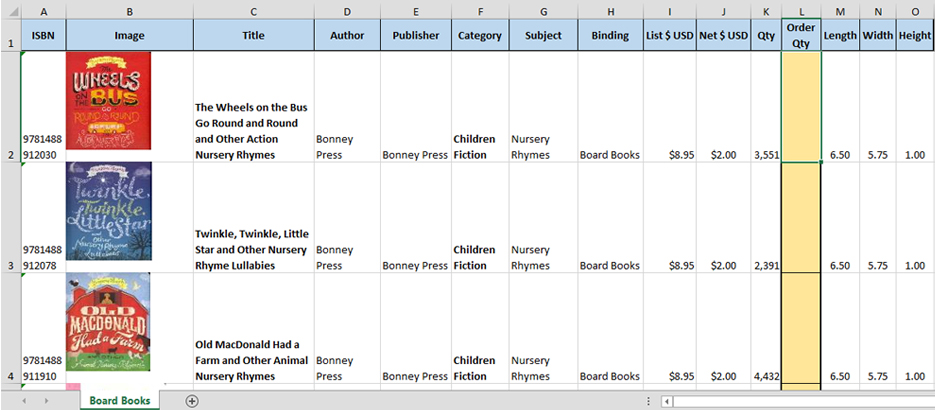
To anyone who has not previously worked from a list and is uncertain of what they may look like, please see the example below. This is just one of the many formats of our lists, but no doubt is a good example worth sharing.


The Power of the List - Bargain Book Lists


Please feel free to reach out to your dedicated sales representative or our customer service team for list inquiries. We are happy to help and hope to make your search an easy one!


Paul Eccles

Sales Representative

Book Depot

Sidebar

Customer Success Story: Royal Botanical Gardens

October 24, 2018

Customer Success Story: Royal Botanical Gardens


Royal Botanical Gardens’ Background

Royal Botanical Gardens (RBG) is the largest botanical garden in Canada, a national historic site, and registered charitable organization with a mandate to bring together people, plants, and nature. RBG protects and restores over 2,000 acres of nature sanctuaries and creates gardens that beautify the landscape. They also serve tourists and locals by hosting events and educating about the work they do through tours and their gift shop. RBG’s gift shop sells educational games, garden decor, figurines, books for kids and adults alike, and much more.

RBG’s began selling bargain books in 2008 and became a Book Depot customer in 2009. Since then, their sales have continued to grow year after year. What started out as an endcap of bargain books to give them a try soon grew to two endcaps – one for adults and one for kids. With the demand for more, RBG continued to expand their bargain book selection by branching out to tables in front of the gift shop and even added two additional rolling racks. Even with the extra display space focused on books, they still receive interest for more; however, due to a lack of space, the gift shop physically can’t add any more.


Solution

With RBG’s demand for bargain books continually increasing, they had to get creative with their space to maximize sales. By purchasing more books than they are able to display at one time, RBG can rotate their available stock to keep their displays updated. Book Depot’s variety gives RBG the freedom to cater their selection to their customer base during the interests of the season as well as their special exhibits.


Results

Increase in Sales: RBG’s bargain book sales have increased tenfold over the last ten years.

Not only does Royal Botanical Gardens have tourists visiting the gift shop, but since carrying bargain books, they also have regulars who come with the intent to buy books. By offering a wider variety of items that appeal to the interests of their customer base, RBG has done what many gift shops do not do and that is appeal to a regular stream of locals. By doing so, they have been able to increase their store’s traffic on a day-to-day basis while ultimately increasing store sales.


Quote

“Book Depot offers us a great selection of books at great prices, which we pass on to our customers. This has made us a destination for many people in our area. Books have become one of the top-selling categories in our gift shop.”

Linda Palichuk, Gift Shop Manager – Royal Botanical Gardens

Sidebar

Book Industry Articles: Non-Fiction Continue to Eclipse Fiction

October 17, 2018

The publishing industry is kind of like the movie business. There are always new things coming out – some good, some not so good, and some blockbusters that have a huge impact on the industry for a period of time. For example, the Harry Potter and Twilight series both made a splash on page and screen and dominated the industry for years. However, trends are shifting and non-fiction book sales are on the rise. In fact, non-fiction sales have eclipsed fiction since 2013, and the gap has continued to grow.


Forbes recently released an article looking at this trend of non-fiction sales outperforming fiction. The article goes on to present specific revenue figures to put each category comparison into content. Take a read:


Traditional Publishers Are Selling Way More Non-Fiction Than Fiction

Author: Adam Rowe

Original Article: https://www.forbes.com/sites/adamrowe1/2018/08/30/traditional-publishers-are-selling-way-more-non-fiction-than-fiction/

In the publishing industry, adult non-fiction revenues are soaring above fiction revenues and have been widening the gap for the past five years. Adult non-fiction revenue totalled $6.18 billion across the publishing industry in 2017, while adult fiction revenues reached $4.3 billion, according to Penguin Random House, using data from Association of American Publishers (AAP), the U.S. Bureau of Economic Analysis, and Bookscan.

2013 was the last year that the adult fiction category beat non-fiction in revenue (at $5.21 billion in revenue to non-fiction’s $4.82 billion). Revenues for adult non-fiction have rapidly risen every year since: $4.97 billion in 2014, $5.59 billion in 2015, $5.87 billion in 2016, and finally $6.18 billion last year. In the same five-year period, adult fiction revenues dropped from a high of $5.21 billion in 2013 to 2017’s low of $4.38 billion.

Revenues in the Children’s and Young Adult fiction and non-fiction category, meanwhile, have remained below both adult categories for the five-year period, except for 2016, when it reached $4.47 billion, besting the adult fiction revenues of $4.43 billion.

One caveat should accompany these numbers before we start reporting the death of adult fiction, however: The numbers only account for traditionally published books, and any fiction or non-fiction from the not-insignificant indie self-publishing community is not included. As publishing expert Jane Friedman noted in a Twitter comment about the findings, “The market for fiction may not be shrinking overall, but it may be shrinking for traditional publishers if indie authors’ cheaper titles look more attractive to avid fiction readers.”

The data was presented in an August report from Penguin Random House, though their main focus was on the stability of the book publishing industry. Revenue is largely flat: Overall revenues clocked in at $14.7 billion for 2017, up 0.4% from 2016. “Notable trends during this time period include a rebound in trade (consumer) books and continued double-digit growth for audio,” the report notes. “While ebook sales declined (-4.7%) for the third consecutive year, the pace of decline appears to be slowing down.”

Don’t expect the publishing industry’s impressive non-fiction revenues to change when the data from this year arrives: Given the consistent successes that political tell-alls have enjoyed this year, the adult non-fiction category is continuing strong.


It will be no surprise to hear that political tell-alls have been dominant in the non-fiction category as of recent years. Since the 2016 election, there has been more interest than ever in political non-fiction titles, as consumers want an inside look of the current running of the US government. Variety recently produced an article discussing President Trump’s effect on the publishing industry:


Trump Powers Boom Time for Book Publishers

Author: Brent Lang

Original Article: https://variety.com/2018/biz/news/trump-political-book-sales-increase-1202947911/

President Donald Trump may not be much of a reader, but he’s been a gift to book publishers.

Sales of political books are up 25% year to date, according to NPD Group, powered by such headline-grabbing best-sellers as James Comey’s “A Higher Loyalty,” Michael Wolff’s “Fire and Fury,” and Omarosa Manigault Newman’s “Unhinged.” These novels paint a portrait of a White House in turmoil, but some are pro-Trump tomes, such as “Liars, Leakers, and Liberals,” a fiery defense of the 45th president from Fox News’ Judge Jeanine Pirro.

“There’s a lot going on in the cultural zeitgeist, and that’s translating into increased book sales,” said Kristen McLean, executive director of business development at NPD. “People want to understand what’s going on right now.”

The literary boom is somewhat ironic. Although Trump is a best-selling author of (ghostwritten) books such as “The Art of the Deal,” he’s said he doesn’t care much for reading. He is said to like short memos with lots of bullets. Whereas George W. Bush and Barack Obama used to publish summer reading lists, Trump seems to spend most of his R&R time on the golf course at one of his clubs or watching Fox News.

Non-fiction sales, particularly of political and self-help books, have helped lift a publishing industry at a time when the popularity of fiction is in decline. Sales volume of print books rose 2% in the first half of 2018, with adult non-fiction print book sales jumping 4% to 136 million units, while fiction print sales declined 4% to 63 million units. “Fire and Fury,” Wolff’s scathing look at the president, and “A Higher Loyalty,” a memoir of former FBI chief Comey, sold the first and third most copies of any book during that period, respectively.

At the moment, one book is flying off shelves. That’s Bob Woodward’s “Fear: Trump in the White House,” which had the highest first-week sales of any book in Simon & Schuster’s nearly 100-year history, moving 1.1 million copies. The legendary investigative journalist has inspired Twitter rants from Trump after reporting that White House aides have worked to undermine the president in order to prevent him from imperiling national security. Lexi Beach, the owner of Astoria Bookshop in Queens, said “Fear” sold out immediately, and half of the replacement shipment she ordered is already reserved for customers eager to dig into Woodward’s depiction of an unhinged commander-in-chief.

But “Fear” isn’t an anomaly. Beach said when she first opened Astoria Bookshop five years ago, there wasn’t much demand for books about Beltway drama. That changed with the 2016 election.

“That shifted things,” Beach said. “Particularly after Trump won, we had a lot more demand for books about activism and political engagement.”

Christine Onorati, the owner of Word, a bookstore with branches in Greenpoint and Jersey City, said political titles have always sold well at her shop. She has noticed a spike in interest surrounding historical titles, particularly books about the World War II era and Richard Nixon, another scandal-plagued president.

“People really want to understand how we got here,” Onorati said. “They’re putting a new set of eyes on history. The past has become a little more relevant.”

Of course, not even trade wars, border walls, and Russian collusion can trump the popularity of some cultural phenomenons.

“Nothing’s outselling ‘Crazy Rich Asians,’” Beach said. “That’s the book I can’t keep in stock.”


Comment below and let us know your thoughts on these trends!


Jennifer Harwood

Sales Representative

Book Depot

Sidebar

Selling Sidelines

October 10, 2018

As booksellers, we all know that books are our bread and butter. We all have a great affection for book product—the smell, the feel, the comfort of having a book in our hands. We live and breathe books. Our customers come to our bricks-and-mortar store looking for that special feeling. But what if we could add some jam to that bread and butter? Seriously, who doesn’t like jam? Adding additional product lines to your overall assortment can significantly add a layer of “jam” to your bottom line!


At Book Outlet, our retail store in St. Catharines, Ontario, Canada, we have recently added many new non-book items to enhance our customers’ shopping experience. These product lines do not take away from our book product. Quite the opposite! These non-book product lines actually enhance the overall book shopping experience. We carry many different product lines, including greeting cards, toys, mugs, cozy socks, candles, candy, tote bags and many, many more. We do our best to cater to our core book customers and we look for non-book items we know our bookworm customers will love. We have also added smaller/lower priced non-book product, such as chewing gum, hand sanitizer, bookmarks, etc. around our cash line for impulse shopping! This increases the chances for these non-book items to become add-on purchases, which increases basket size, adding to your overall profitability. Last year, our non-book product represented 17% of our total sales in-store! Finding the perfect mix of non-book items along with great cross merchandising ideas are key to making a cohesive shopping experience.


Our team at our St. Catharines store has done a fabulous job in identifying non-book product lines that work well for our clientele. It is imperative that you identify successful product lines for your customers’ interests.


That being said, here are a few of our favorites:


Toy product:

Toys are a natural sideline to most product types. Many people shop either with their children or for their children. One brand we carry is Melissa & Doug. They have amazing products, such as puzzles, games, puppets, pretend play, and many others that will enhance your customers’ experience!


Clothing:

Okay, I know what you may be thinking. How the heck am I going to merchandise clothing in my bookstore? I am talking about scarves, socks, and yes, even T-shirts! We carry Out of Print product, which is perfect for the bookworm in your life who has read everything but would love anything that features their favorite book! From mugs to tote bags, this is excellent non-book merchandise for any bookstore.


Tea and Tea Product:

I don’t know many bookworms who do not enjoy a hot cup of tea while snuggled up reading their favorite book! We currently carry a line of tea product from Tea Forte. From loose-leaf tea to boxed tea, tea cups and tea pots, Tea Forte has it all!


Blankets/Throws:

I am an avid reader. I have blankets and throws throughout my entire house in all my favorite reading places. I have bought many of these items while shopping at my local bookstore (totally guilty!); therefore, I can attest that carrying this non-book product in bookstores works! We currently have a line of blankets and throws from NorthEast Fleece Company that customers have been very receptive to.


Lower priced impulse items (chewing gum, candy, hand sanitizer, wrapping paper, etc.):

We carry a number of different lower-priced product lines in our cash line-up and they sell consistently! These impulse products may not be the reason why a customer came into your store, but they sure do make a difference in the basket size and bottom line.


These are just some of the recent sideline products we have identified for our retail location. Don’t limit your search! There are many companies offering this type of product. Do your research. Get the best margins! Ensuring the non-book product you decide to sell meets your customer base is essential to its success at your store. Don’t know where to start? Ask your key customers what they’d like to see to enhance their shopping experience. Done right, sidelines will add another dimension/texture to your bookstore. They may even bring in a new customer who hasn’t purchased from your store in the past. They also make it possible to do more add-on selling and will keep customers in your store for longer periods of time, enticing them to buy more and ultimately adding revenue to your bottom-line!


Tracy Basnett

Category & Store Operations Director

Book Depot

Sidebar

Maximize Your Purchasing Power

October 3, 2018

It is hard to believe that we are 10 years removed already from the market crash of 2008 and how much that has shaped our current business practices and how we operate. One of the things I have observed over the years, at least in our industry, is the higher demand on suppliers to deliver value-added services for their products, preferably at no extra cost to the buyer.

Properly defined, purchasing power refers to the “value of a currency expressed in terms of the amount of goods or services that one unit of money can buy.”1 So, it involves how much currency (money) a consumer has and how that translates into the amount of buying power the individual can exercise—or, simply put, how much you can buy with the money you have.

I would like to take a bit of different spin on this and contend that most buyers have a fairly fixed budget they can spend (for instance, on bargain books), so what is important to them and allows them to maximize the power of their purchase is to get as much for that budget as they possibly can. While your budget will dictate the maximum amount of physical product you can buy, if you are also receiving extra services when you buy that product, it will ultimately save you time and money, increasing the value of that purchase beyond the worth of the product.


More for Budget Dollars

When I relate this to the purchases you make at Book Depot, you are getting books on average between 75 – 90% off the publisher’s SRP. Certainly, for schools, libraries, and other institutional purchasers, this is a huge savings for your organization when buying bargain vs. direct from your front-list distributor. We see how institutional budgets are often being cut and government funding is being pulled, so buying bargain books is a great way to increase the power of your purchase. In doing some research while writing this blog, I came across this article from 1978 that speaks to looking for remaindered and bargain books to stretch your library’s budget dollars!

It is fascinating to see how individuals 40 years ago would go about researching and acquiring bargain books and how far we have come today with an enormous supply of product available to you at the click of your mouse.


Save on Shipping Costs

Another area where Book Depot can help increase the profitability in your purchase is through our consolidated freight options. With fuel costs on the rise and shipping companies continually raising their prices, doing bulk shipments of several orders can be a huge cost savings for you and help you stretch those purchasing dollars. At Book Depot, we offer you the ability to hold orders in our shipping department (for a reasonable amount of time) to bulk up your shipments and send a pallet of product at a better freight rate as opposed to multiple smaller and more costly shipments. And if you are one of those buyers who starts building an order online and has to come back to it several times over a period of a week or two before you feel like it’s large enough to fill a pallet, we would encourage you take advantage of this by making multiple orders over a shorter amount of time that we can consolidate for you. This way, you won’t see all those great titles disappear from you cart because it took you longer than you had hoped to finish your purchase. If you want to read more about consolidated shipping, please read our How to Lower Your Shipping Costs blog, which explains how you can start saving money.


Book Depot Delivering on Service

Some final thoughts on how Book Depot gives you more for you purchasing dollar—we treat each and every order, no matter the size, with the same care and respect that each customer deserves. We take great pride in two key areas that help improve customer satisfaction: an order fill rate of higher than 99% and a damaged book claim rate of less than 0.5%. We also take the time to make sure the books are clean and free of any price stickers that may have been in place from previous retailers. What that means to you is your orders will be accurate and complete, and your books will be undamaged and clean. When you spend your valuable budget with us, you can be assured that you will get what you ordered.

At Book Depot, our vision is to see increased profitability spurring on an evolving but vibrant retail book market. Making you, our customer, more profitable through value-added services and ease of ordering with our website is how we want to help you maximize your purchasing power with Book Depot!


Rick Mechelse

Book Depot

Online Sales Manager


______________________

1 Investopedia. n.d. Purchasing Power. Accessed September 21, 2018. https://www.investopedia.com/terms/p/purchasingpower.asp.

Sidebar

Oddball Authors

September 12, 2018

For centuries, authors have been providing us with great stories of adventure, mystery, romance, comedy, and so much more. If you’ve ever found yourself wondering how they do it, you’re not alone! We were curious too, so we set out to find the quirkiest routines and most superstitious beliefs that have transpired behind the scenes to create some of the greatest pieces of literature in history. But don’t take our word for it; without further ado, here’s our list—we hope you enjoy reading it as much as we did compiling it.


Victor Hugo (1802-1885)

Most known for: Les Misérables

Victor Hugo’s antics while writing The Hunchback of Notre Dame on a very tight schedule is the perfect way to start the list. In order to hit his deadline, Victor put himself on self-imposed house arrest for months, knowing that he would have to start paying fines if he didn’t hit his February 1831 deadline! He locked his clothes away to avoid any temptations to leave and only allowed himself to keep one grey shawl so he would be forced to stay inside and write.1


James Joyce (1882 – 1941)

Most known for: Ulysses

James Joyce was known for writing while lying on his stomach in bed with a large blue pencil, donning a white coat. Since James was nearly blind, the large writing utensil helped him see what he was writing and the white coat helped reflect more light onto the page. A typewriter would have helped him write easier and faster; however, he straight out refused because he was always seeking the “perfect order of words in the sentence” and wanted to write at his own pace and in his own hand. After what James would have considered a productive day, he would have completed two sentences.2


Edith Sitwell (1887-1964)

Most known for: Still Falls the Rain

British poet Edith Sitwell found inspiration in confined spaces. Before she would start writing for the day, Edith would always clear her mind by laying in an open coffin.3


Agatha Christie (1890-1976)

Most known for: Murder on the Orient Express

Agatha Christie had her own favorite writing place—in the bathtub. When she was renovating her home, Agatha had one request for the architect: “I want a big bath and I need a ledge because I like to eat apples.” For her, it was not about indulging; the bathtub was her prime work space.4

Agatha Christie books available here.


Vladimir Nabokov (1899-1977)

Most known for: Lolita

Vladimir Nabokov wrote entire novels on index cards. This allowed him to write scenes non-sequentially, as he could then easily rearrange the cards as he wished. Fun fact: his novel Ada was written on more than 2,000 cards.5

Nabokov in America: On the Road to Lolita available here.


Thomas Wolfe (1900-1938)

Most known for: Look Homeward, Angel

Thomas Wolfe gave himself a writing quota of ten pages, triple-spaced, every day. Not only did he have a page count to meet, but Thomas would also do this daily writing while leaning over his refrigerator since he was so tall (6’6” to be exact).6

Thomas Wolfe’s You Can’t Go Home Again available here.


Eudora Welty (1909-2001)

Most known for: The Optimist’s Daughter

Eudora Welty used to straight-pin her stories together in strips so they could be seen as a whole as she wrote. Welty even mentioned to a friend once that “[w]hen the stories got too long for the room I took them up on the bed or table [and] pinned and that’s when my worst stories were like patchwork quilts, you could almost read them in any direction.”7


Anthony Burgess (1917-1993)

Most known for: A Clockwork Orange

Anthony’s tool to fight off writer’s block was a dictionary. When he found himself stuck while writing, he would grab a dictionary and attempt to use every last word on the page he opened. When he would come across the need to describe a dull object, he would use the same strategy by attempting to use every word on the page in the description alone.8


Truman Capote (1924-1984)

Most known for: In Cold Blood

While some authors had unique writing habits, Truman Capote brought his superstitions into his writing process. He “wouldn’t begin or end a piece of work on a Friday, would change hotel rooms if the room phone number involved the number 13, and never left more than three cigarette butts in his ashtray.”9

Truman Capote’s A Christmas Memory available here.


Maya Angelou (1928-2014)

Most known for: I Know Why the Caged Bird Sings

Maya Angelou wouldn’t write from the comfort of her own home but would instead rent a hotel room on a monthly basis. She would routinely start at the crack of dawn right until the early afternoon. Nobody would be allowed to enter during that time unless it was to clear out items in the room to remove distractions. The only items she allowed exceptions for were “a bottle of sherry, a dictionary, Roget’s Thesaurus, yellow pads, an ashtray, and a Bible.”10

Maya Angelou books available here.


Stephen King (1947-present)

Most known for: The Shining

Stephen King may be known for his horror writings but that does not mean he is impervious to fear. Stephen King suffers from triskaidekaphobia – fear of the number 13. He has said that, “[w]hen I’m writing, I’ll never stop work if the page number is 13 or a multiple of 13; I’ll just keep on typing till I get to a safe number. When I’m reading, I won’t stop on page 94, 193, or 382, since the sums of these numbers add up to 13.”11

The Stephen King Companion available here.


George R.R. Martin (1948-present)

Most know for: A Song of Ice and Fire Series

George R.R. Martin considers himself “a man of the 20th century” because he still writes with a DOS computer that is not connected to the Internet. He uses WordStar 4.0 as his word-processing system and says that this program (released in the late ’70s) “does everything I want a word processing program to do and it doesn’t do anything else. I don’t want any help. I hate some of these modern systems where you type a lowercase letter and it becomes a capital. I don’t want a capital. If I wanted a capital I would have typed a capital.”12

George R.R. Martin books available here.

Dan Brown (1964-present)

Most known for: Angels & Demons

Dan Brown concentrates on his writing by putting on a pair of gravity boots and hanging upside down since he believes inversion therapy helps with his writing process. On top of that, he also keeps an hourglass on his desk so that on the hour, every hour, he sets aside his work to do push-ups, sit-ups, and other exercises.13

Dan Brown’s Angels & Demons available here.


J.K. Rowling (1965-present)

Most known for: Harry Potter Series

J.K. Rowling refuses to title a piece during the writing process and has said that she will only type up the title page once the book is completely finished.14


Valerie Stark

Marketing Coordinator

Book Depot


______________________

1 Joyce, James. 1966. Letters of James Joyce. London: Faber and Faber.

2 Johnson, Celia Blue. 2013. Odd Type Writers. New York: TarcherPerigee.

3 Ackerman, Diane. 1990. A Natural History of the Senses. Vintage Books USA.

4 Johnson, Celia Blue. 2013. Odd Type Writers. New York: TarcherPerigee.

5 Ackerman, Diane. 1990. A Natural History of the Senses. Vintage Books USA.

6 Wolfe, Tom. 1991. “Tom Wolfe, The Art of Fiction No. 123.” The Paris Review (118). https://www.theparisreview.org/interviews/2226/tom-wolfe-the-art-of-fiction-no-123-tom-wolfe.

7 Marrs, Suzanne. 2011. What There Is to Say We Have Said: The Correspondence of Eudora Welty and William Maxwell. New York: Houghton Mifflin Harcourt.

8 Illuminati, Chris. 2017. “10 Odd Writing Habits Of Famous Authors.” https://www.oddee.com/list/odd-writing-habits-famous-authors/.

9 Inge, M. Thomas. 1987. Truman Capote: Conversations. Jackson: University Press of Mississippi.

10 Angelou, Maya. 1990. “Maya Angelou, The Art of Fiction No. 119.” The Paris Review (116).

11 Rogak, Lisa. 2009. Haunted Heart: The Life and Times of Stephen King. New York: Thomas Dunne Books.

12 Martin, George R.R. 2014. “Game of Thrones author George RR Martin: ‘Why I still use DOS’.” BBC. http://www.bbc.com/news/technology-27407502.

13 Henley, Jon. 2013. “How Dan Brown and other authors defeat writer’s block.” The Guardian. https://www.theguardian.com/books/shortcuts/2013/may/13/dan-brown-authors-writers-block.

14 Rowling, J.K. 2015. “The Weird World Of Writer Superstitions.” Writers Relief. http://writersrelief.com/blog/2015/10/writer-superstitions/.

Sidebar

Book Industry Trends

September 5, 2018

As a bookseller, one of the fun aspects of our job is identifying trends that we notice from within the broad spectrum of accounts Book Depot works with. While some of the trends may be unique to one account’s particular industry or location, others may be considered on a larger scale and are applicable to all the accounts we work with. As sales people, we may not always be right when it comes to our intuitions, though I must confess it’s always fun trying to keep up with the times and knowing what our customers like best!

To name a few examples, we could look at the Who Is/Who Was series that has been a great success within recent years. If you were to look at our sales history for these titles, you would find that they have been popular within libraries, educational retailers/distributors, and children’s book fair industries. Another example is to look at stores that focus on music and pop-culture. Obvious trends you might notice are musicians who are growing in popularity, or perhaps you might see increased sales with books relating to a movie when it is released in theatres.

I’m sure by this point, you get where I am going in regard to trends, but what about the less obvious ones? It can be more difficult to discover trends when you aren’t looking at an overall category, though the insight to be found is all the more intriguing. As a brief synopsis, I’ve compiled some interesting trends that I’ve researched from within the book industry. While these trends may not be accurate to every book retailer, hopefully you’ll find these examples as interesting to read as I did. Furthermore, if there are any trends you’ve noticed in your own stores, we’d love to hear from you by commenting below the article!


Anxiety / Finding Happiness

One of the more interesting reports recently is that sales analysis at Barnes & Noble reported a 26% increase in sales of books that are relating to anxiety.1 Conversely, books about finding happiness have grown by a substantial 83% within one year. While there’s numerous opinions and reasons as to why this may be happening, it’s a good reflection as to the motivation people have for self-improvement.


Horror Sales at Four-Year High

TV shows such as Stranger Things and movies such as Stephen King’s IT are being credited with helping titles with horror and ghostly subject matter reach a four-year high in the UK.2 I’ve found it difficult to find similar data pertaining to Canada or the United States, though my personal observations would align with this. At Book Depot, we’ve been fortunate to regularly receive some of Stephen King’s greatest works; however, as you can imagine, they tend to sell quickly!


Rise of the Independent Bookstore

According to the American Book Association, there was a 35% increase of independent book stores opening between 2009 and 2015.3 This has driven the total number of independent bookstores to an excess of 2,300 in total as noted by the ABA.

Though this news is not necessarily new, I thought this was worth noting as it’s a great indication of the overall health of our industry. Book Depot has welcomed working with independent bookstores from all corners of the globe, and we always find it interesting to see the unique and regional selections they choose to purchase when working with us.


Increased Collaboration Between the Comic & Gaming Industries

While there is no doubting the size of the gaming community, there may be a wave or movement to capitalize on the substantial size of the industry by having more comics-oriented publishers collaborate with gaming developers. Sales of comics and graphic novels totalled an estimated $1 billion revenue in North America in 2017, while data according to SuperData Research puts the total for video gaming in excess of $108 billion.4 Though some of those developers may already have a published brand, others who do not may seek to close the gap between the value of the comic/graphic novel industry versus that of video games.


Soaring Popularity for Political Books

With the incredible sales driven by James Comey’s A Higher Loyalty (over 600,000 copies sold in its first week) and Michael Wolff’s Fire and Fury (over 2,200,000 copies sold so far this year), it should come as no surprise that the adult nonfiction segment has reported an increase of 4% during the first half of 2018.5 Books that are political in nature have taken center stage through much of this year and intriguingly enough, this popularity has crossed categories into both the children’s and fiction categories respectively, while titles such as A Day in the Life of Marlon Bundo (by John Oliver) and The President in Missing (a collaboration by James Patterson and Bill Clinton) have topped the charts.

As there are more books yet to be released by both Michelle and Barack Obama later this year, all indications are that this trend won’t be slowing down anytime soon.


Poetry in the United Kingdom

Reports from the UK note that there has been an increase of 66% in poetry book sales over the past five years.6 According to a survey by Taking Part Survey, 3.1% of the adult population in England wrote their own form of poetry in 2015/2016.

View our poetry book selection here.


STEM (Science, Technology, Engineering & Math) Making Its Rounds Internationally

General feedback being shared from book fairs such as the Taipei Book Fair and Bologna Book Fair are indicating that there has been a growing trend towards books relating to STEM subjects. From my own observation, I’ve seen numerous accounts taking a focus on this type of title. In particular, this has been evident with titles we have by Miles Kelly, but also with reading series such as the earlier mentioned Who Is series, as well as titles within the Ready to Read, I Can Read, Penguin Young Readers and other reading series that are similar in nature.


Paul Eccles

Book Depot

Sales Representative


______________________

1 Green, Dennis. 2018. Barnes & Noble says books about anxiety are trending because ‘we may be living in an anxious nation’. August 1. Accessed August 31, 2018. https://www.businessinsider.com/barnes-and-noble-anxiety-book-sales-trending-2018-8.

2 Lyons, Izzy. 2018. Horror fiction sales at four-year high after a glut of supernatural series and films. July 14. Accessed August 2018, 2018. https://www.telegraph.co.uk/news/2018/07/14/horrorfictionsales-four-year-high-glut-supernatural-series-films/.

3 Raffaelli, Ryan, interview by Paddy Hirsch. 2018. Why The Number Of Independent Bookstores Increased During The ‘Retail Apocalypse’ (March 29). Accessed August 31, 2018. https://www.npr.org/2018/03/29/598053563/why-the-number-of-independent-bookstores-increased-during-the-retail-apocalypse.

4 Salkowitz, Rob. 2018. Ready Reader One: Game Developers Look Toward Comics. August 10. Accessed August 31, 2018. https://www.publishersweekly.com/pw/by-topic/industry-news/comics/article/77744-ready-reader-one-game-developers-look-toward-comics.html.

5 Milliot, Jim. 2018. Print Unit Sales Rose 2% in First Half of 2018. July 6. Accessed August 31, 2018. https://www.publishersweekly.com/pw/by-topic/industry-news/financial-reporting/article/77441-print-unit-sales-rose-2-in-first-half-of-2018.html.

6 Onwuemezi, Natasha. 2018. Poetry sales are booming, LBF hears. April 13. Accessed August 31, 2018. https://www.thebookseller.com/news/poetry-summit-766826.

Sidebar

Why It Is Important for Your Business to Give Back

August 21, 2018

The “give back” movement has been experiencing a groundswell of support over the last several years and does not see any signs of experiencing a drop-off in the near future, especially with the tumultuous political and social climate we are all experiencing. This philosophy is lived daily at Book Depot in all that we do, whether it is partnering with nonprofits to help them procure books for fundraisers or donating books for literacy drives. We feel this is a core value that permeates our organization from ownership all the way through the entire team. You may certainly be thinking to yourself, “why should I be giving back?” or “I do not have the financial resources to give.” It is a completely understandable reaction. However, we have come up with a list of possible ways to give back in your community that could perhaps jump-start your own initiative.


Book drives

For minimal cost, you can place a box in your store earmarked for your customers to donate their slightly used books. Then either on a regularly scheduled date, or simply as the box fills, you can deliver them to a local school, shelter, or other charity (a coin donation box at the checkout also does the trick).


Your gift of time

Your time is certainly of value. If you and your team can set aside a day—or even an afternoon—to provide meals, do a charity walk, or adopt a section of highway, you will be making a difference. It is also an awesome team bonding experience!


Sales percentages

Set aside a designated day to provide a portion of your proceeds to a local charity. One suggestion would be on “Giving Tuesday.” This year it will occur on November 27 and has become as ingrained in the public conscientiousness as Black Friday and Cyber Monday. It does not have to be a large portion; even 5% would go a long way in making a difference.


Offer your space

Provide a space in your store for a nonprofit to utilize as meeting space. It could be at a traditionally slow time or during off-hours, so it does not negatively impact your operation. Who knows, someone in attendance could buy a book…


Benefits

As people, we give mostly for selfish reasons—because it feels good. It nurtures our souls and gives us a sense of pride that we made a difference in the lives of the less fortunate. As a business, benefits stretch far beyond that and include (but are not limited to):

  1. Ignites your customer base. 85 percent of customers prefer businesses and brands that support a charity they care about, translating to higher traffic and sales revenue in your store.1
  2. Charitable donations are tax deductible if you are supporting an IRS/CRA approved nonprofit organization.
  3. Increased visibility by free marketing and publicity. Oftentimes charities are exceptional with getting the message out. Whether it is with the local media or on their social media pages, they will promote your organization for the assistance you provided. (Side note: do not forget to reciprocate the favor by promoting them on your own social media channels.)
  4. Employee relations. People love working for organizations that are not just out for themselves or to only turn a profit. Those businesses that care about their town and their neighbors will have a happier team and be more attractive to prospective employees in the future.
  5. Strengthens your market reach. A more literate community means a larger customer base. An example of this would be how providing books for schools ignite a child’s love of reading, turning them into readers who are looking to expand their own book collection.
  6. Create customer loyalty. 90 percent of customers say they would be more loyal to a brand that gives to a local cause that resonates with them.2


Get started

Lastly, you may be thinking, “where would I even start”? There are thousands of deserving charities and nonprofits that could easily resonate and are well-deserving. We suggest three starting points. First, start locally. No better place to make a difference than in your own backyard. Second, start small and build upon your success step-by-step. You will look back in a few years and be amazed at what you were able to do in a relatively short amount of time. Lastly, we suggest you “take a backseat” on this one. It is certainly easier said than done when we are used to leading every aspect of our businesses, but on this topic, let your team decide democratically who will be the benefactor of your resources. Your group experience will have a much higher chance of success if everyone buys into the philosophy of giving back.


Good luck and please let us know how your group made a difference. We would love to celebrate your successes on our social channels!


Greg Sizelove

Business Development Director

Book Depot


______________________

1 Heitzman, Adam. 2016. Why Giving Back Should Be Part of Your Marketing Strategy. May 10. Accessed August 8, 2018. https://www.inc.com/adam-heitzman/why-giving-back-should-be-part-of-your-marketing-strategy.html.

2 Tabaka, Marla. 2015. Why It’s Crucial for Your Company to Give Back. January 26. Accessed August 8, 2018. https://www.inc.com/marla-tabaka/7-reasons-to-become-a-philanthropist-now.html.


Photo courtesy of Bernie’s Book Bank.

Sidebar